Slurry Separator FAQs
03/17/2026
How to Choose Right Meat and Bone Processing Equipment?
05/15/2026Slurry Separator FAQs
03/17/2026How to Choose Right Meat and Bone Processing Equipment?
05/15/2026Pomegranate juice has become a high-demand product in the global beverage market. For producers, investing in a modern, automated pomegranate juice production line is the key to achieving high yield and consistent quality. In this guide, you’ll discover:
- How does a pomegranate juice line work step-by-step
- Key equipment involved
- Investment cost and ROI analysis
Whether you’re a startup juice brand or an established food processor, this guide from Furui Machinery is a must-see solution.
Pomegranate Juice Production Process
The pomegranate juice line generally follows these steps:
Raw Pomegranates → Washing → Aril Separation (Peeling and Deseeding) → 3-Stage Purification → Vibration Dewatering → Manual Sorting → Juicing → Filtration → Degassing & Sterilization
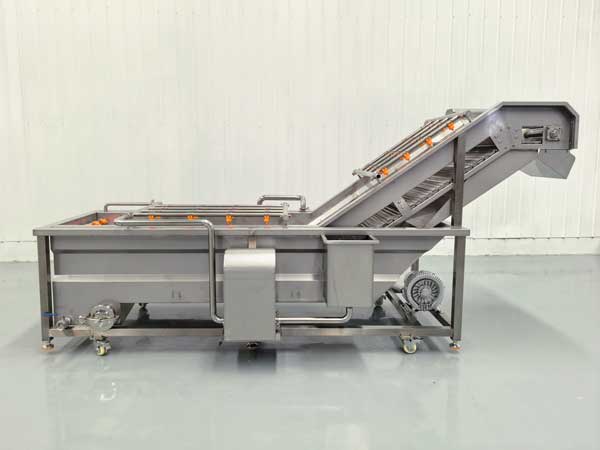
1. Washing: Remove dirt, pesticides, dust, and bacteria from the pomegranate fruit surface.
Equipment: Air bubble washing machine
2. Pomegranate Aril Separation (Peeling & Deseeding): Separate pomegranate arils from the outer peel and white membrane without crushing the arils. Intact arils = higher juice yield (75–90%) and premium juice quality.
Equipment: Pomegranate Peeling & Deseeding Machine
3. Purification: Remove unwanted materials, such as white membrane pieces, peel fragments, and foreign matter from arils. Membranes contain tannins, which may cause a bitter taste and poor clarity.
Equipment: 3-Stage Purification System (Vibration Sieve, Flotation Cleaning, and Vibration Sieve)
4. Vibration Dewatering: Remove surface water from arils before juicing.
Equipment: Vibration Dewatering Machine
5. Manual Sorting: Inspect and remove defective arils, foreign matter, or contaminants manually.
Equipment: Sorting Conveyor Belt
6. Juicing & Filtration: Extract juice from arils, then filter to achieve desired clarity.
Equipment: Screw Type Juicer/ Fruit Pulper
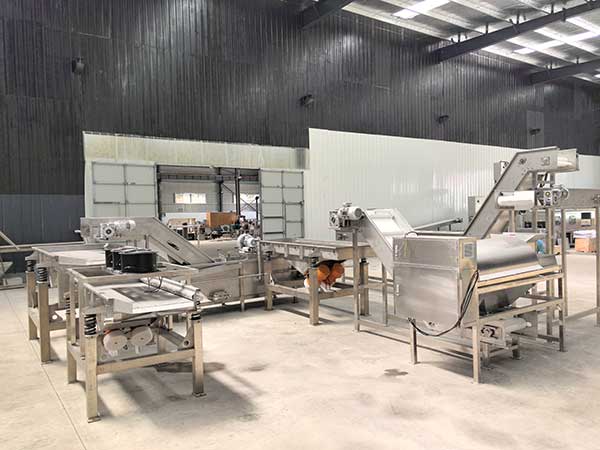
Pomegranate Juice Line
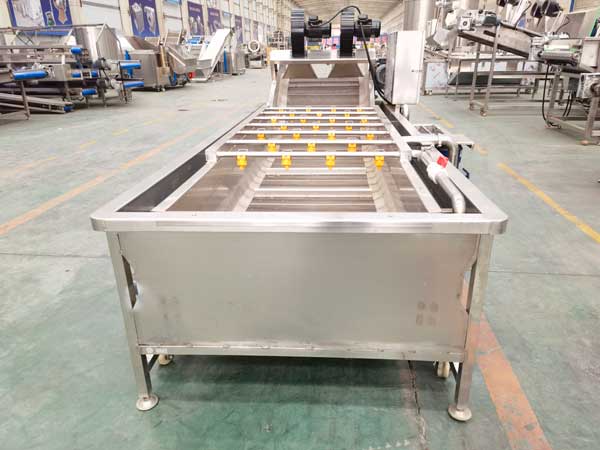
Air Bubble Washing Machine
Key Equipment Used in Pomegranate Juice Line
Below is an equipment list of our pomegranate juice line.
|
Equipment |
Function |
Advantages |
|
Air Bubble Washing Machine |
Wash raw pomegranates |
- No fruit bruising (gentle bubbles) |
|
Pomegranate Peeling & Deseeding Machine |
Separates arils from peel/membrane |
- Patented no-damage tech (90% intact arils) |
|
Elevator |
Transports arils to purification system |
- Food-grade plastic belt - Smooth, continuous flow |
|
Purification System |
Removes tiny debris, light membranes & peel fragments |
- Water filtration & recycling |
|
Vibration Dewatering Machine |
Removes surface water from arils |
- Removes 80% surface water |
|
Manual Sorting Conveyor |
Manual inspection & defect removal |
- Removes discolored/damaged arils |
|
Screw Type Juicer |
Extracts juice from arils gently |
- No bitter taste |
|
Filtration System (Coarse + Fine) |
Filtration of fresh juice |
- Removes coarse fibers and large impurities - Clear juice, no sediment |
|
Vacuum Deaerator |
Removes oxygen & air from juice |
- Prevents oxidation of pigments, vitamin C, and flavor - Maintains bright red color |
|
Sterilizer |
Sterilizes juice bacterially |
- 93°C for 20 seconds (flash pasteurization) - Commercial sterility |
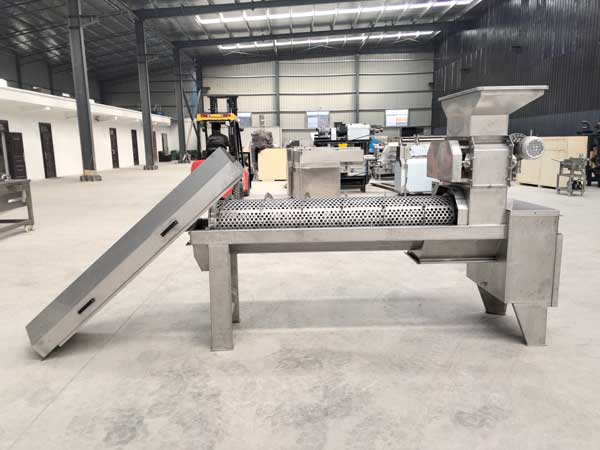
Pomegranate Peeling Machine
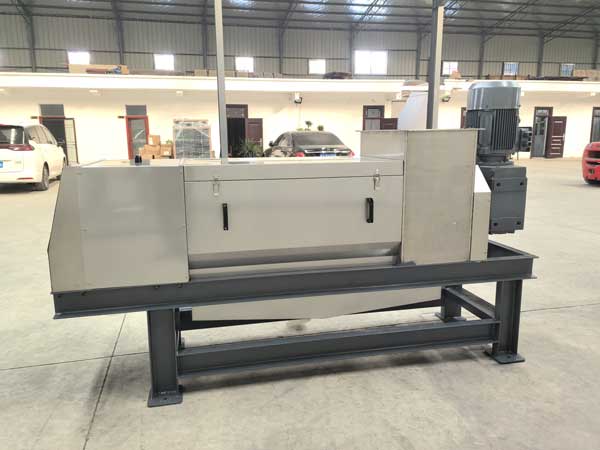
Screw Press Juicer
Cost, Yield, and ROI: What to Expect (2026)
1. Equipment Cost
The main investment cost is the equipment cost. A complete pomegranate juice production line ranges from $30,000 to $200,000, depending on the equipment used and processing capacity. Furui Machinery's complete 1-t/h line costs approximately $80,000-$130,000 for equipment alone.
2. Production Yield & Output
| Input | Output | Conversion Rate |
| 1,000 kg of pomegranate fruit | 550-750 kg arils | 55-75% aril yield |
| 1,000 kg of pomegranate fruit | ~600 kg juice | 60% juice yield (85-90% from arils) |
- Fresh Pomegranate Fruit Wholesale Price: Midpoint (Europe, 2024): ≈$1,650/ton (average of $1,450–$1,850)
- Pomegranate Juice Wholesale Price: Midpoint (Europe): ≈$3,530/ton
- Raw material: $1,650/ton × 1.67 tons fruit = $2,756 per ton juice
- Selling price: $3,530/ton juice (bulk NFC), $5,000-7,500/ton (NFC bottled juice)
- Gross Margin: 22% ($3,530 – $2,756 = $774 profit/ton)/54% ($6,000 – $2,756 = $3,244 profit/ton)
Note: The data here are only for your reference.
FAQs
Q1: How much does a pomegranate juice production line cost?
A complete 1-ton/hour automatic line costs $90,000–$160,000 for equipment. The cost varies depending on the capacity and the equipment used.
Q2: What is the juice yield of this pomegranate juice line?
It is about 55-60%. You can get about 55–75% aril yield from pomegranate fruits and our screw juicer machine can get an 85-90% juice yield.
Q3: Does pomegranate juice taste bitter?
Not exactly. Bitterness comes from crushed seeds releasing tannins. Our patented deseeding machine separates arils with no damage, and the purification system removes all membranes. Result: sweet, bitter-free juice.