How to Choose Right Meat and Bone Processing Equipment?
05/15/2026
Shipping Two Sets of Cow Dung Separators to Peru
07/28/2026How to Choose Right Meat and Bone Processing Equipment?
05/15/2026Shipping Two Sets of Cow Dung Separators to Peru
07/28/2026Choosing the right slurry separator is one of the most practical decisions a dairy manager makes. A good separator reduces lagoon and handling costs, improves waste management, creates valuable byproducts, lowers hauling frequency, and helps farms meet environmental regulations. But “best” depends on the farm’s slurry characteristics, farm size, budget, and intended use for the separated solids and liquids. This article compares common technologies, including screw separators, centrifuge separators, and sloped screen separators, and explains how to select the right solution for your dairy operation.
Why Do Dairy Farms Need Slurry Separation?
Slurry separation helps dairy farmers reduce costs, improve nutrient management, and create valuable by-products from cow manure.
- Lower Storage Cost – Separating solid and liquid will greatly reduce the waste volume that must be stored in lagoons.
- Reduce Transportation Cost – Dewatered solids are light, stackable, and far more economical to move than raw slurry.
- Better Nutrient Management – Solids contain a significant portion of phosphorus and organic matter, while liquids are easier to apply as fertilizer.
- Improved Bedding Recovery – Many dairy farms reuse separated solids as cow bedding, helping reduce the cost of sand, sawdust, or straw purchases.
- Easier Manure Handling – Separated liquid and solid can be further processed separately. For example, the dewatered solids are primed for composting; the separated liquid is the ideal feedstock for biogas systems.
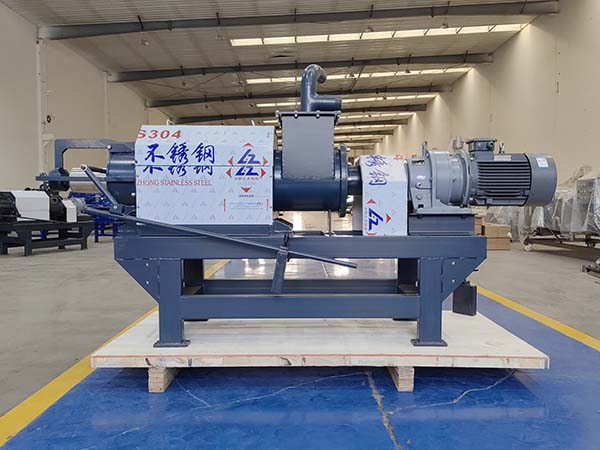
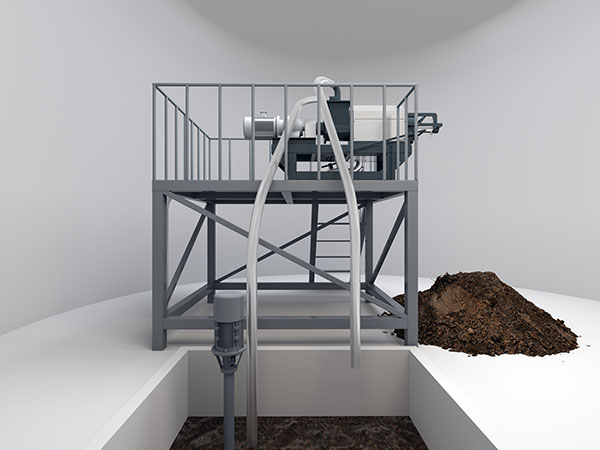
Slurry Separator

Manure Separator in Bangladesh
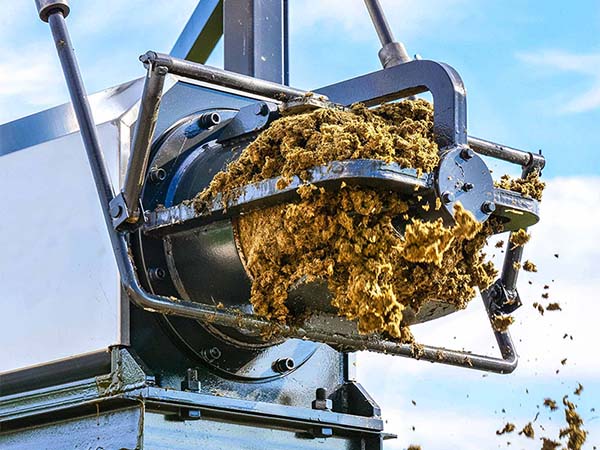
Dewatered Cow Dung
3 Main Types of Slurry Separators
1. Screw Slurry Separator
A screw separator uses a rotating screw inside a screen cylinder. As the screw pushes the slurry forward, the space narrows, creating mechanical pressure that forces liquids out through the screen while compressing the solids forward and discharging from the outlet. Typical dewatered solid liquid content for screw presses is around 55–60%.
2. Inclined Screen Separator
A sloped screen separator uses gravity. Slurry flows over an inclined screen where gravity and vibration let liquid pass through while solids slide down to collection. The solids will pass through a screw press for further dewatering. The typical liquid content of dewatered solids is around 70%. A sloped screen separator is suitable for thin slurry (over ~90% liquid).
3. Decanter Centrifuge
A decanter centrifuge works by spinning slurry at high speed inside a horizontal bowl. Based on density, heavier solids are forced outward while the lighter liquid stays closer to the center and separates out. Then, a rotating screw conveyor moves the solids to the discharge end while the clarified liquid exits through the center.
Here is a comparison table for your reference.
| Item | Screw Separator | Slope Screen Separator | Centrifuge Separator |
| Separation Mechanism | Mechanical Screw Compression | Gravity & Screw Press | High-speed Centrifugal Force |
| Feed Slurry Liquid Content | >70% (Scraped or flushed) | > 90% | Broad range (fine solids) |
| Ability to Handle Fibrous Manure | Excellent | Good | Moderate |
| Ability to Handle Sand-Laden Manure | Moderate (sand causes wear) | Good | Moderate |
| Fine Particle Capture | Moderate | Low | Excellent |
| Dewatered Solid Liquid Content | 55–60% | Around 70% | 55–65% |
| Energy Consumption | Low | Very Low | High |
| Maintenance Requirements | Low | Very Low | High |
| Operating Cost | Low | Very Low | High |
| Liquid Clarity | Good | Limited | Excellent |

FR-380 Slurry Separator
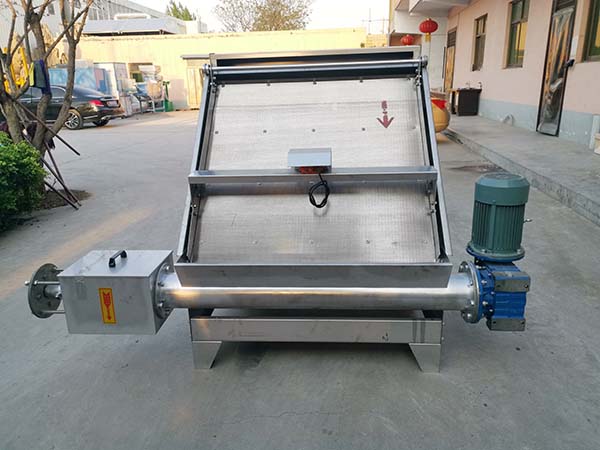
Sloped Screen Separator
Which Slurry Separator Is Best for Your Dairy Farms?
Here are some key factors to consider when choosing a suitable separator.
- Herd size and manure volume
- Liquid content of manure slurry
- Budget and operating costs
-
Choose a Screw Slurry Separator if...
If your dairy farm is handling scraped or flushed manure with more than 70% liquid content, screw slurry separator is the most popular choice. Furui Machinery offers 3 models:
FR‑180 for farms under ~200 cows;
FR‑280 for ~200-400 cows;
FR‑380 for farms over 500 cows.
-
Choose an Inclined Screen Separator if...
Our sloped screen separator is suitable for slurry with >90% liquid content. If your farm uses a water flushing system where the slurry is highly diluted, our sloped screen separator will be a great choice. The resulting solids retain around 70% liquid content, which is ideal for further processing. Furui Machinery also has 3 models for sale. You can choose according to the slurry volume.
-
Choose a Decanter Centrifuge if...
Choose a decanter centrifuge if you want a clearer liquid phase after separation, or you need better removal of fine particles than a simple screen can provide. But it is not suitable for materials with large fibers. Besides, it requires higher capital and operating costs, higher energy consumption, and more complex maintenance.
A Quick 3-Step Guide: How to Choose
1. Match by feed slurry consistency
-
Very thin slurry (>90% liquid): Sloped screen separator is the best first step.
-
Scraped or flushed slurry (>70% liquid): Our screw slurry separators perform very well here.
-
Fine or heterogeneous slurry with high solids fraction: A decanter centrifuge will be a better option.
2. Match by herd size
Select a suitable model based on daily slurry volume and herd size. If you are unsure about capacity requirements, our team can help calculate the right model based on your farm’s actual conditions.
3. Balance ROI vs. Budget
Compare capital cost, energy consumption, and maintenance cost. A well-matched separator can significantly reduce long-term operating costs and improve overall farm profitability.
Furui Cow Dung Dewatering Solutions
For dairy farms aiming for lower moisture levels, a single machine isn't always enough. We specialize in configuring multi-stage systems to maximize ROI:
1. Sloped Screen Separator + Screw Separator
For large flush dairies, we route the thin slurry (>90% liquid) through our sloped screen separator first. The gravity-dewatered solids are then instantly fed into a screw separator. This combination allows you to handle high-volume liquid while still achieving optimal 50-60% liquid content solids.
2. Screw Separator + Screw Dewatering Machine
We pair our slurry separator with screw dewatering machine. The dual-stage dewatering process can lower the final liquid content down to an impressive 40%. If you have any questions, contact Furui Machinery today with your herd size and manure management setup. Our engineers will provide a free and custom solution for your farm.