Chili Sauce Production Line
12/18/2025
Shipping Sesame Paste Production Line to Oman
01/14/2026Chili Sauce Production Line
12/18/2025Shipping Sesame Paste Production Line to Oman
01/14/2026From real production experience, hummus is one of the most process-sensitive plant-based products. Its final quality depends on:
- Chickpea softness after cooking
- Grinding fineness
- Temperature control
- Air removal before storage and filling
Furui Machinery designs and offers complete hummus production line solutions for commercial or industrial uses, such as medium- or large-scale factories, food brands, and more. Below we take a 200-300 kg/h hummus production line for example to explain how the equipment is selected.
Industrial Hummus Production Process
A standard industrial hummus production line typically follows this process:
Chickpea Soaking → Cooking System → Lifting & Feeding → Grinding → Mixing, Seasoning & Vacuum Deaeration → Cooling → Filling and Packaging
1. Raw Material Preparation
Chickpea Cleaning: The first step is to thoroughly clean the chickpeas to remove any impurities, such as dirt, stones, or damaged beans.
Soaking: Soaking the chickpeas for 8-12 hours is necessary. This step softens the chickpeas and reduces cooking time, helping to improve grinding efficiency and final texture.
2. Cooking
After soaking, the chickpeas are typically boiled or steamed in large industrial cookers. This step aims to create soft, uniform chickpeas, which is essential for making smooth texture of hummus.
Equipment Used: Cooking Kettle
3. Lifting & Automatic Feeding
Cooked chickpeas are transferred via a bucket elevator to the feeding system.
- Reduces manual handling
- Ensures steady, controlled feeding
- Improves overall production efficiency
This step is especially important for medium or large capacity production lines, where labor optimization matters.
Equipment Used: Bucket Elevator
4. Colloid Grinding
The colloid grinder is the core machine in an industrial hummus production line, which grinds the chickpeas into a smooth, fine paste. Furui's colloid grinder allows you to adjust the grinding gap for fineness control.
Equipment Used: Colloid Grinder
5. Mixing and Seasoning
At this stage, tahini, lemon juice, olive oil, garlic, and other flavorings are added to achieve the desired consistency and taste.
Equipment Used: Tanks and Pump
6. Packaging
Once the hummus has the desired texture and flavor, it is transferred to a packaging line, where it will be filled and packaged.
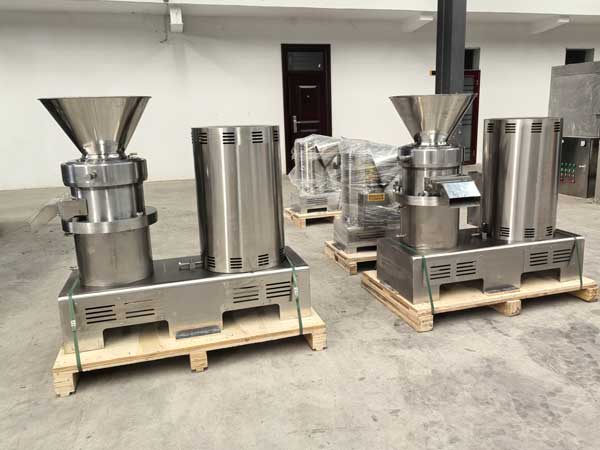
Colloid Grinders for Sale
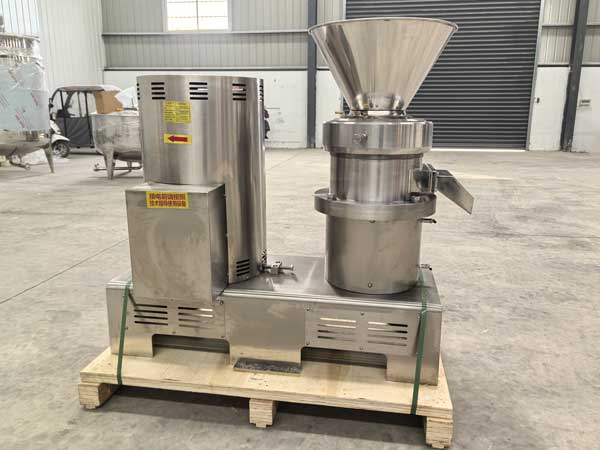
Hummus Grinder
Equipment Used in Hummus Production
Instead of focusing on individual machines, Furui Machinery designs the line based on how hummus behaves during cooking, grinding, emulsification, and storage. Here is the equipment list of a 200-300 kg/h hummus production line.
| No. | Equipment | Power | Quantity | Function |
|---|---|---|---|---|
| 1 | Cooking Kettle | 48 kW | 1 | Chickpea cooking to achieve full softness |
| 2 | Bucket Elevator | 0.75 kW | 1 | Material lifting to the next process stage |
| 3 | Storage Hopper | 0.04 kW | 1 | Provides buffering and stable, continuous feeding |
| 4 | Colloid Grinder | 11 kW | 1 | Grinding and emulsification of chickpeas |
| 5 | Storage Tank (200 L) | 1.1 kW | 1 | Stores hummus temporarily before further processing |
| 6 | Paste Pump | 1.5 kW | 2 | Transferring paste to the next stage |
| 7 | Vacuum Tank (500 L) | 4 kW | 1 | Removes entrapped air, improves color and shelf life |
| 8 | Storage Tank (1000 L) | — | 1 | Temporary storage before filling |
| 9 | Piping & Valves | — | 1 set | Hygienic connection |
| 10 | Control Cabinet | — | 2 | Control of the production line for stable operation |
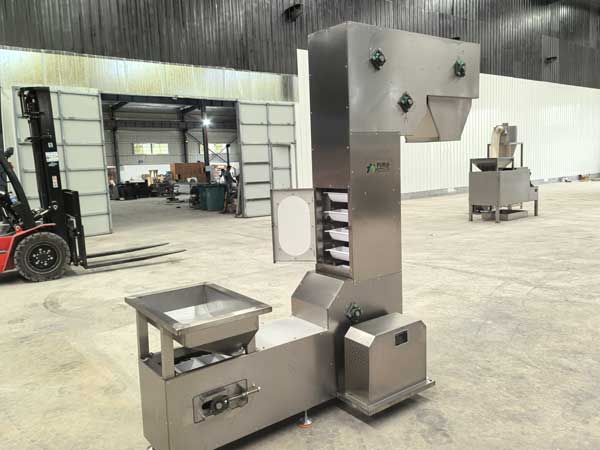
Bucket Elevator
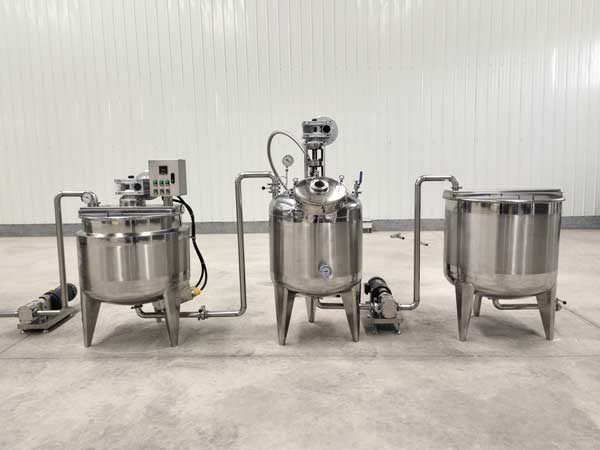
Tanks
How to Choose Hummus Processing Equipment?
1. Raw Material Considerations: Steamed vs. Fried Chickpeas
Will you use dry chickpeas or frozen chickpeas? Will you choose fried vs. steamed chickpeas? The first step is deciding what kind of chickpeas you’ll use. The raw material will directly influence the equipment and process flow. For example, dry chickpeas require soaking, cooking, and sometimes washing. Equipment needed includes soaking tanks, cooking kettles, and washing systems. For fried chickpeas, frying equipment and proper cooling systems will be used.
2. Confirm Your Desired Hummus Textures
Where is your target market? Texture preferences vary across markets. Different textures require different grinding intensity and processes. Furui offers hummus grinders with adjustable fineness and stator and rotor designs that allow coarse or fine textures, to meet your requirements.
| Market | Texture | Recommended Process |
|---|---|---|
| Middle East | Dense, traditional, smooth or slightly coarse | Fine or coarse grinding |
| EU/US | Creamy, uniform, smooth, lighter mouthfeel | Fine grinding, homogenization |
| Foodservice/Bulk | Thick, highly stable | Medium/fine grinding, stabilization equipment |
3. Choosing the Right Capacity
Whether you are starting with a single colloid grinder or scaling to an automated line, defining your desired output per hour is crucial. Our team can help recommend equipment that matches your capacity.
Conclusion
Producing consistently high-quality hummus requires more than just machines. Furui Machinery provides custom solutions, from cooking, grinding, to vacuum deaeration and packaging. Contact our engineering team today to discuss your target capacity and texture requirements. We will offer you a customized hummus production line.